Our idols and demons will pursue us until we learn to let them go*

1: The Eagle
It's easy to speak to the dead. Start by observing patterns; degrees of separation, one deceased person to the next. Consume something that reminds you of them. Watch a film, read that book you promised them you'd get to but never did. Remember what they told you about it. Start an argument with them in your mind.
The strongest link in the chain between the living and the dead is art. Art the dead made, art the dead recommended. Artists they raised. When I was a child, my father would plant little seeds in my mind. Names, titles, things he thought I would enjoy once I was old enough. And my brain catalogued every single one. I'm still trying to catch up on them all—and I will—even if I can't talk to him about them anymore. He was an artist too. I'm certain he would have been a professional cartoonist or illustrator if he hadn't lost his sight.
At the time of his death on July 10, 2025, at 73, my father had several sketches hidden away in a box: Peter O'Toole in Lawrence of Arabia, Orson Welles in A Man for All Seasons. Paul McCartney for my mother, caricatures of friends and depictions of World War II where the Nazis were cats, and the Jews were mice, at least a decade before the publication of Art Spiegelman's Maus (1986). He was firm that nobody should see them after he died. I wanted to frame them. Out of the question.
One of the last films I remember us watching together was Return of the Living Dead (1985) in the early 90s. By then, he had to sit very close to the television and squint to make anything out. He missed many details, and I tried to describe them as best I could, but it wasn't the same. I asked for some more horror-comedy recommendations. The first titles that came to his mind were Flesh for Frankenstein (1973) and Blood for Dracula (1974), but they'd be hard to find (small town; smaller video store), but then—on second thought—no, I should forget about those for now. Never mind. I could see the instant regret setting into his face, so I filed them away in the neuro-index for later.
I tracked them down in my 20s. I'd never seen two films so beautiful and debauched, evocative and absurd. Flesh for Frankenstein and Blood for Dracula became a catalyst in cementing my love of 'lowbrow' art, to see vulgarity as something to revel in rather than be ashamed of; revealing profound truths, where you are free to go to places that are melodramatic, camp, grotesque, and inelegant. It's beautiful. It's validating. The weirdos are our safe people, and no actor felt safer or embodied this chaotic sublime more than Udo Kier, who taught me there is no such thing as a guilty pleasure.
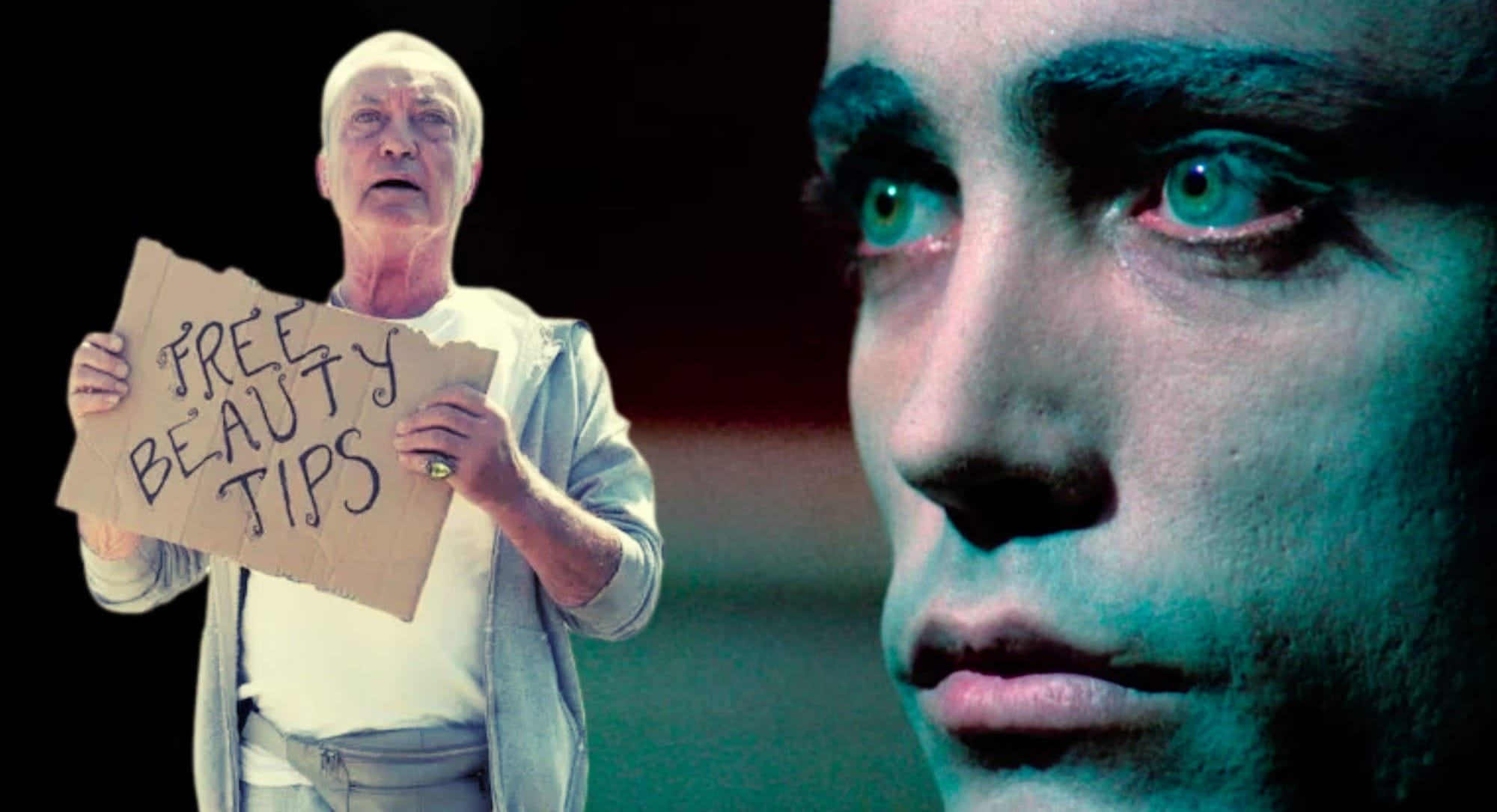
I first knew him as Hans, 'the lamp man' in My Own Private Idaho (1991). Kier appears halfway through as a client of the two central characters, sex workers Mike (River Phoenix) and Scott (Keanu Reeves). Hans tells them he used to be a 'performer' and sings for them, prancing around the room with a shaded lamp, the light illuminating his face in a sinister way that contradicts the absurdity of his little dance. The song Hans sings, 'Der Adler' ('The Eagle'), was a single Kier himself released in 1985. It sounds as if Falco did a new-wave Halloween parody of Leonard Cohen's First We Take Manhattan, with less crooning and more yelling. In the music video, he plays a mild-mannered computer scientist who turns into an eagle at night. At one point, he pops out from behind a tree, mid-transformation, adopting the mannerisms of a bird of prey, shouting: "They'll never find me! I control their minds! I want to control ev-ery-thing!" There was a knowing smirk he would get on his face, both on and off camera, when he was revelling in nonsense.
At the time of his death on November 23, 2025, at 81, Udo Kier had 276 acting credits to his name, of which he said about 100 were bad, 50 were fine when paired with a glass of wine, and 50 were good. Still, he never said we should avoid the bad ones. In fact, he always had something positive to say about every project. He wanted to be seen in ev-ery-thing. Every syllable must be delivered like a sledgehammer to the ear; anything that appealed was worth doing. He found his family that way. Found art.
Udo Kierspe was born in Cologne in 1944, at the tail end of World War II. Just moments after his birth, the Allied forces bombed the hospital. He and his mother spent three hours buried beneath the rubble before they were rescued, and he was the only baby to survive. They had very little. He would go with her to church and work as an altar boy until he left home to take menial jobs, because his mother couldn't afford to send him to high school. That was when he met Rainer Werner Fassbinder. They spent their time at working-class pubs, mixing with the queer community and underground artists. Kier was openly gay from a young age; Fassbinder already comfortable in his own bisexuality.
I had such a horrible childhood. My father was already married with three children when I was born and my mother didn't know. So we grew up poor. We had no hot water until I was 17. I went to work in a factory, and worked and saved for months until I had the money to come to England.
Kier's acting career began when he moved to London in his early 20s to study English. Singer Michael Starne approached him in a coffee shop and offered him a role in his debut film, Road to Saint Tropez (1966), a 30-minute comedy with a melancholy undertone; an innuendo-filled travel diary, narrated by a middle-aged English woman (Melissa Striblig) who picks up Kier's character in her convertible driving through the South of France. A brief 'acquaintanceship' follows. He spoke very little, and someone dubbed his lines into French. He was window dressing, and he liked it.
It seems he was intended to be another Helmut Berger or Alain Delon—the striking leading man; the heteronormative love interest. There's a little edge to some of his earlier roles, like Schamlos (1968), Mark of the Devil (1970) and Proklisis (1971), but you can tell he's holding back. There was rigidity, an uncertainty there. Almost a mask. He hadn't found his niche yet, but he was on the right track, in with the right crowd.
No one knew exactly what colour his eyes were. Some say blue; some say grey. In one interview he said green; on another occasion, that it depended on the light. He didn't know either. My estimate would be teal. I study eyes on screen, because it's the only time I'm comfortable making eye contact. Don't ask me the eye colour of anyone I'm close to. I couldn't tell you. Sometimes I pause the frame, tilting my head like a dog trying to understand a command, like an alien visitor, moving close to the screen to study the details, as one would a painting. You can't look at Udo Kier for too long, though. Your mind plays tricks on you. Time seems to eat itself. I have a ritualistic way of consuming art. It's a sensory connection. I like to count the freckles in the iris. I know what a cathode ray smells like.
2: Flesh and Blood
Udo Kier met Paul Morrissey on a plane, told him he was an actor, gave him his number, and that was that. Morrissey was an all-rounder in the New York art scene, managing Andy Warhol and The Velvet Underground for a time. When Valerie Solanas attempted to assassinate Warhol in 1968, Morrissey took charge of the film department. He was drawn to outsiders, embracing the libertine nature of underground cinema and casting many LGBTQIA+ performers from Warhol's Factory, observing the lives of the fringe dwellers, the addicts, the hustlers and counterculturists.
Morrissey was a walking contradiction, caught between two worlds. A conservative Catholic who disapproved of his collaborators' lifestyles, yet couldn't seem to stay away, believing his personal morals were irrelevant to his work, that it was essential to have 'empathy' for the people on screen; to show their true humanity.
At the time of his death on October 28, 2024, at 86, Paul Morrissey had 25 directing credits to his name, having alienated many of his former collaborators, a reputation for screaming at journalists, barking resentful slurs about Warhol and complaining about immigrants. Morrissey never considered his work 'political', brushing off everything—even profound, provocative moments in his films—as 'funny' or 'silly', anything to not address the 'empathy' he used to espouse in any substantial way. Never admitting what drew him to the same forms of subversion repeatedly; why his go-to actor was Joe Dallesandro, the Factory security guard until Morrissey took one look at him and immediately put him in front of the camera. It was a baffling career that left the director in a permanent state of frustration, for reasons we can only speculate.
Morrissey's earlier films were entirely improvised, and he never shot more than two takes. Even the second was just a security measure. Most of the actors were untrained and unknown. They were given the freedom to vibe off each other and draw on personal experience, as Morrissey believed everyone 'acts' as soon as they are in front of a camera.
Flesh for Frankenstein and Blood for Dracula were shot back-to-back over two months, with a combined budget of $350,000. This time, there was a script, but nothing was set in stone. Morrissey still encouraged improvisation; mistakes and happy accidents only added to the comedy. For Frankenstein, Kier learned anatomy from an actual doctor and picked up Latin medical terms, but got them all mixed up once the cameras were rolling. Though it departs entirely from the source material, it does parody the hubris of the titular character. In this version, Baron Frankenstein lives in a cold, sterile-looking mansion with his bitter, unfulfilled sister, Baroness Katrin Frankenstein (Monique van Vooren), who is also his wife and the mother of their two children. Together with his assistant, Otto (Arno Jürging), Frankenstein strives to create a Serbian master race of reanimated 'zombies' of his own design, to bend to his will alone. With a female body already secured, his next goal is to find a perfect head for her male counterpart.
The Baron has a disgust of pedestrian sexuality, preferring to rummage around in the guts of his subjects, squeezing their organs and using incisions for his own pleasure—much to Otto's confusion. "To know death, Otto," he says, pointing a bloodied hand at the corpse, "you have to fuck life...in the gallbladder." Morrissey said the intention was to parody a seedy line he hated from Last Tango in Paris, but Kier ended up saying the words 'life' and 'death' the wrong way around. What was intended as a simple (albeit awkward) thematic statement ended up sounding like a life-affirming mantra for perverts and eugenicists.
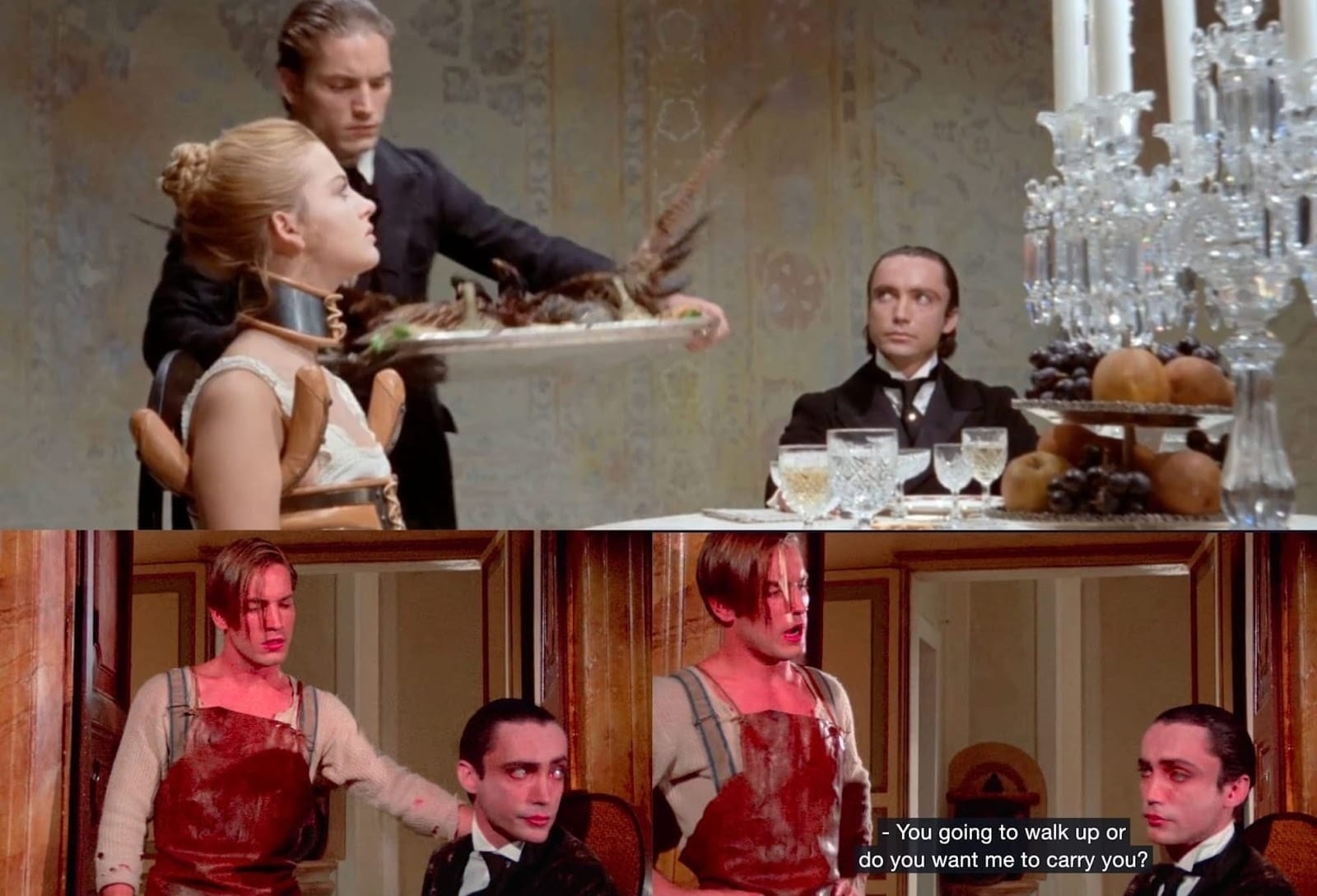
The film really hits its stride when the Baron seats his two creations at the dinner table to meet the family. Nicholas (Dallesandro), the Baroness' new 'manservant' and lover, is serving dinner. He walks down the long, candlelit table, a pair of large pheasants comically arranged on a silver platter as he and the Baron eye each other suspiciously. Come for the candlelit mise-en-scène, stay for the bitchy stares.
When filming wrapped on Frankenstein, Kier recalled sitting in the canteen on set, aware that Fellini was shooting a film next door, and feeling a melancholy resignation. He thought his Warholian 15 minutes were up. That was until Morrissey came in and announced that Srdjan Zelenovic, who had played the male zombie, would no longer be playing the title role in Blood for Dracula, and offered it to Kier. He was required to lose 20 pounds in a week, not for aesthetic reasons, but because Morrissey wanted him to look ill. When he arrived on set, he was so fatigued that he had to sit in a wheelchair, which became a staple for the sickly, irritable Count who is doomed unless he can find the blood of some 'wirgins'.
Dracula shares the same tone as Frankenstein: comedic, gore-filled, horny, and morally dubious, with no semblance of the original novel. It's the same plot, too: liberated peasants against a repressed, predatory nobility. Dallesandro is once again the servant who resents his employers and is the town bike in his spare time, and Arno Jürging is back as Kier's sidekick, Anton.
Kier's Dracula possesses a vulnerability unlike the deviant and pompous Frankenstein. A wet blanket on the verge of a nervous breakdown; he sulks and whinges, fumbles awkwardly with his victims and stuffs everything up royally. He lacks supernatural power and creeps around like a Scooby-Doo villain, worrying about looking suspicious. One minute eliciting pathos, looking up from his sick bed with pleading eyes, the next proclaiming: "The blood of these whores is killing me!" as we revel in his pain.
In both films, Kier, with his maniacal expression and German accent, is an excellent contrast to Joe Dallesandro's nonchalance and detached New York drawl. Joe grunts; Udo shouts. Joe rolls his eyes; Udo's pop out of his skull. Joe strides; Udo stumbles. Joe underreacts; Udo overreacts. Joe was some guy from the wrong side of the tracks, and Udo was from another planet. It's a delightful symbiosis, and satisfying to see two queer men from non-privileged backgrounds, who stumbled into the acting profession based on their looks alone, develop—with minimal direction—performances that were effective extensions of themselves.
3: Revelation
Things slowed down for a few years after Kier finished his work with Morrissey. He dipped his toes in erotic art films like Story of O (1975), then it was back to horror with The House on Straw Hill (1976) and, of course, he shows up halfway through Dario Argento's Suspiria (1977) to provide five minutes of obligatory and vague exposition.
One of Kier's first films of the 1980s, Walerian Borowczyk's The Strange Case of Dr Jekyll and Ms Osbourne (1981) shares gothic sensibilities with Flesh for Frankenstein and Blood for Dracula, but that's where the similarities end. It's a nasty, Vaseline-smeared fever dream that I'm sure I had experienced well before I saw it. Kier completed the classic 19th-century trifecta, playing Dr Henry Jekyll. While he has less screen time (and the film ultimately belongs to Marina Pierro as his fiancée), it is a more restrained performance that proved he could unsettle without excess. You expect the scene where Jekyll submerges himself in a bathtub filled with a mysterious yellow fluid before transforming into his evil alter ego (played by Gérard Zalcberg) to be a thrashing, extravagant sequence. It's not. When Jekyll looks in the mirror, his eyes turning a sickly shade of red and orange, you see a new era in his face. The icy stare he became famous for in the second half of his career.
Back in Germany, he reunited with Fassbinder and lived with him in Munich for a time. They made a few films together, including The Third Generation (1979), Lola (1981) Lili Marleen (1981) and the television miniseries Berlin Alexanderplatz (1985). None of them were major roles, but they broadened his oeuvre, leading to a fruitful decade in both realist and experimental cinema, including several projects with Christoph Schlingensief. Though heavily inspired by Fassbinder, Schlingensief had a more comedic, intertextual sensibility, which allowed Kier to once again whip up a psychodramatic storm. In Egomania (Island without Hope) (1986), he plays an incarnation of the Devil who torments a young couple on a bleak, liminal island. One of the first times we see his character, Baron Tante Teufel ('Devil's Aunt'), he is dressed in red and black, with a cloak, top hat, and a moustache, shielding his eyes from the sun's glare. Like Count Dracula, but more imposing and somehow more unhinged. He rolls around in the dirt and eats it, gags, shouts and sobs. In one scene, he dresses in drag, and the camera lingers on his face as he applies black and red makeup that recalls the opening titles of Blood for Dracula. Then, he and his servant run around in fast motion, like Benny Hill swallowed the Keystone Cops, tripping over and giggling, at one point tying the female protagonist, Sally (a young Tilda Swinton), to the mast of a boat and dancing around her to music that sounds like it belongs in a Russ Meyer film. Oh, and he eats a baby, in the most Udo way possible.
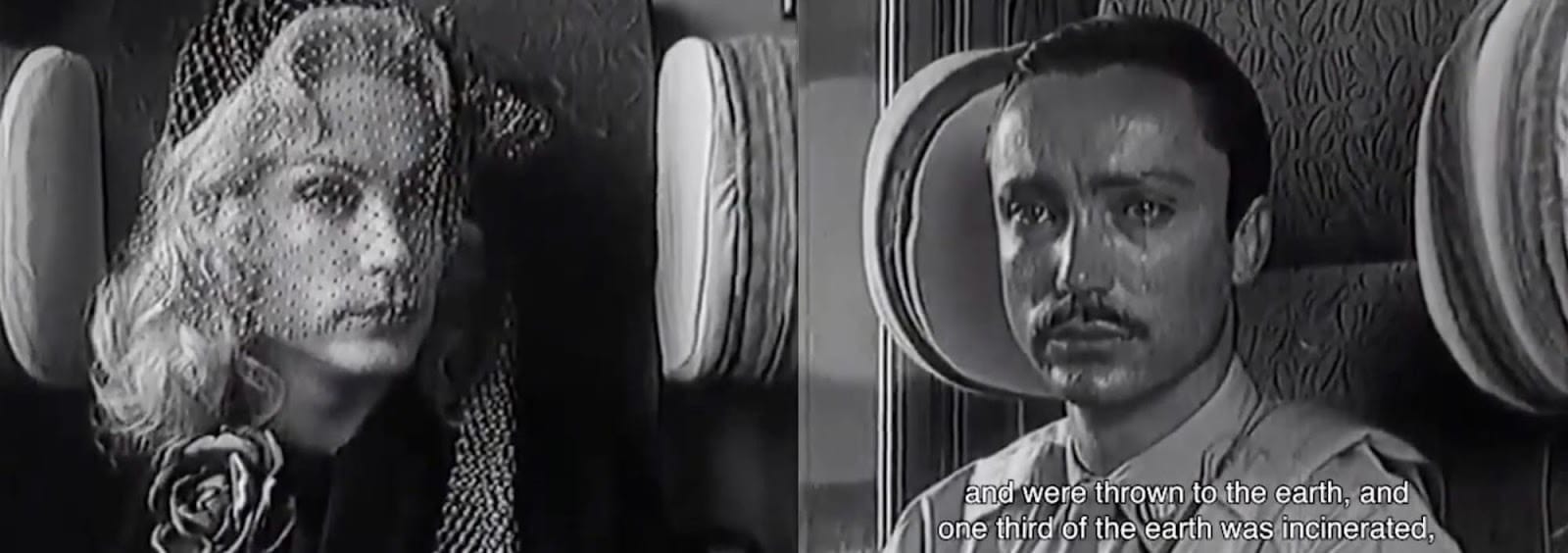
For me, Kiers' most fascinating project of the 80s was his directorial debut, the short film, The Last Trip to Harrisburg (1984), which I only got around to seeing after his death. Concerned about ongoing Cold War tensions and a recent accident at a nuclear facility in Mannheim, he transferred the anxiety over the looming threat of nuclear war back to the place where his life was nearly over before it had even begun: Nazi Germany. A man and a woman (both played by Kier and voiced by Fassbinder) sit opposite each other on a train, quoting Bible passages at each other, bookended by footage of a man slaughtering a sheep inside a church. You can see both Fassbinder and Schlingensief's influence, and though he later brushed the film off as the result of snorting two grams of coke and then reading the Bible, it's clearly personal. You can't help but feel the parallels with Kier's childhood, his near-death immediately after his birth, and his Catholic upbringing. At the climax of the film, the man and the woman repeat the same verses about 'death in the womb' back to each other with increasingly heightened emotions, as though Kier is arguing with himself, or reenacting a quarrel between his parents. The woman shouts the last lines:
And there shall be war cries at noon in broad daylight, for he did grant me death in the womb, nor afford my mother to be my grave—her womb pregnant for eternity! For what purpose must I emerge from the womb, only to endure such heavy disdain and disgrace! Cursed be the day upon which I was born. Cursed be the day my mother gave birth to me. This day shall not be blessed, when the man cheerfully rejoiced to my father: "A son is born to you!"
The camera lingers on the man as she speaks. Tears stream silently down his cheeks. The woman's voice stops, and a child takes over. I studied this frame. Like a dog, like an alien. I'd never seen his face look quite like that before. It's the face of remembering, of inescapable trauma.
4: My body can't take this treatment anymore.
I get headaches all the time, but around August of this year, I had one with symptoms that mirrored the debilitating migraines my father would get. A comfort film was what I wanted, but my face needed a cold pack. I couldn't look at a screen. It had to be something I'd seen before.
With the audio isolated, Blood for Dracula is a whole new experience. It begins with Claudio Gizzi's delicate and melancholy piece, 'Old Age of Dracula', playing over the credits as a gaunt, sickly Count Dracula, with powdery white skin, meticulously applies black greasepaint to his white hair and eyebrows. Then, he smears a slightly metallic red over his lips that blends with the traces of black still on his fingers to create a gradient that looks deliberate. I shed a tear from my sickbed, moved merely by the gentle tinkling of the ivories and comforting lilt of that very 70s clarinet.
Focusing just on the dialogue, I appreciated the affected line delivery even more. Despite the range of accents on display, it feels cohesive, yet free. Kier is delightfully petulant, his cadence somehow both slurred and precise. Arno Jürging, as his bossy servant Anton, delivers his lines in a clipped, intense way that recalls 1930s Universal Monster movies, a highlight being when he shouts "No!" several times at his master, like he's chastising a naughty dog.
I forgot how awful Joe Dallesandro's Mario is. A farmhand with no concept of consent; telling the rich girls ('hoors') he works for that they'll be first against the wall when the revolution comes. It's a tough one. The film seems to make fun of quasi-socialists and men who cannot live up to their own principles. Mario has a hammer and sickle painted on his wall and gets defensive when someone underestimates his intelligence ("I read books too, you know!"), eventually revealing himself to be arguably more of a predator than Dracula. Yet, knowing what we know about Paul Morrissey, maybe that's just how he saw the Left-Wing: hypocritical and degenerate.
It's so much easier to criticise this film when you don't have to look at it. When this farce first got it's grubby claws in me, I was 23 and stoned; a sad little Edgelady watching hot naked people and a silly vampire on a grainy VHS rip. How do I justify this now? Do I need to? I was pushing myself into a moral quagmire. Maybe there isn't a grander explanation for bad taste and I'm just a tacky broad who once read John Waters' memoir? Maybe migraines make me a killjoy. Still, I couldn't deny I was enjoying my little aural experiment, and my favourite scene was coming up. The clumsy Count accidentally drinks the blood of a non-virgin, poisoning himself, resulting in a prolonged sequence where he vomits copious amounts of blood over the white porcelain bathroom fixtures. First the toilet, then the bathtub. Eyes wide, mouth gargling blood. Even without Kier's contorted face, the sounds on their own were remarkable. I found myself in a fit of laughter that made my head throb.
"Dad, is this a migraine?"
"Think so."
"So this is my inheritance?"
A soft chuckle. "Listening to Dracula vomit won't help."
"But it is, strangely enough."
As the monumental purge eased to a few spluttering coughs, I felt a little better. I dozed off for the rest of the movie's runtime, lifting the ice pack off my face in time to see Mario 'save' the only virgin in the house from Dracula, the only way he knows how. Soon, Kier is stumbling down flights of stairs, screaming and whimpering as Dallesandro chases him around with an axe, eventually removing every limb in a scene that predates—and is funnier—than the Black Knight in Monty Python and the Holy Grail. I closed my eyes again to hear the Count's wheezing demise interrupted by the shrill, devastated scream of one of his female victims, now a vampire herself. My headache was gone.
I wonder now if, at that moment, Udo Kier knew he was going to die.
5: I'm at your house
You anticipate Udo Kier when you see his name in the credits and smile when he comes on screen. It's often a case of 'blink and you'll miss him', though he presented several convincing arguments for being a ubiquitous bit-parter. For example, if a film flops, it's often blamed on the lead, who may, as a result, become less in demand. No one blames the supporting actors. Plus, he enjoyed putting a little something into the minor roles to make them memorable. Perhaps this was the key to his longevity.
By the 90s, like many European actors over 40 working in Hollywood, he mostly played villains. Shady types. Creepy dudes. Nazis. Kier played Hitler more than once (but never outside of a comedic context; he set that rule for himself) as well as a bonkers Russian supervillain in two Command & Conquer games (1996 and 2001), another vampire in Blade (1998), doctors, shrinks, priests or just the guy behind the whole dang nefarious plot who has five minutes of screen time before being offed.
Kier was often compared to Terence Stamp, who, at the time of his death on August 17, 2025, at 87, had appeared in 96 films. They had similar bone structure and eyes, both oscillating between high and lowbrow. When they appeared together in Revelation in 2002, Kier recalled that on set, to settle things once and for all, he and Stamp stood together in front of a mirror. They couldn't see any resemblance at all. Granted, it was more obvious when they were younger. That was the It-Boy look back in the day, which became the Sinister Silver Fox by the turn of the millennium. From then on, if you found out a famous actor from the 60s and 70s had a cameo in a movie, your guess would be Kier, Stamp, or Malcolm McDowell, who has more credits than both and shows no signs of slowing down.


LtoR: Udo Kier in Mark of the Devil (1970), Terence Stamp in Teorema (Theorem) (1968), Stamp and Kier in Revelation (2002).
I don't like the term 'character actor'. It implies an actor who doesn't have what it takes to play a lead. Not conventionally attractive, too unorthodox to be bankable, but it also points to a prevalent form of ageism in the industry, one that prefers youth and beauty over experience and eccentricity. Directors who know how to use actors like this use them well, not just for a kooky diversion or as a random weirdo on the street; they add something tangible. A case in point is David Lynch, who, at the time of his death on January 15, 2025, at 78, was everyone's favourite: favourite filmmaker, favourite artist, favourite kook, favourite parasocial dad. Kier was a huge fan.
I remember when I saw Lost Highway, with Bill Pullman and Robert Blake, and (Blake) is on the phone with the little red lipstick and he says, "I'm at your house!" And I thought, "Ugh! That could have been (my character)!"
Kier and Lynch made so much sense. So much so that sometimes I forget they never worked together. He was going to be in Twin Peaks, but there were scheduling conflicts with My Own Private Idaho. The lamp number in the latter is strangely reminiscent of Dean Stockwell in Blue Velvet, lip-syncing to 'In Dreams' behind an old-fashioned microphone with a light inside. The closest Kier ever got to Lynch was My Son, My Son, What Have Ye Done? in 2009, a Lynch Production, directed by Werner Herzog. His role is substantial, and the best thing about the film. Lynch's roster of old reliables was vast: Harry Dean Stanton, Jack Nance, Grace Zabriskie, Ray Wise, Catherine Coulson, Patrick Fischler. Kier already had a committed bit-part contract with his close (but less fun) friend Lars von Trier, appearing in most of the director's filmography. He appreciated that von Trier thought of him consistently and approved of his choices. As the perturbed wedding planner in Melancholia (2011) it was Kier's choice to walk around for most of his screen time with his hand over the side of his face, refusing to look at Kirsten Dunst's character because she arrived late and ruined 'his' wedding. Kier said one publication gave his hand a 'Best Actor' award.
Kier's largest role in a von Trier project was in the television series Riget (The Kingdom) (1994-2022). He appeared in all 13 episodes alongside an ensemble cast, and it was a role that loomed large:
I’m happy because I’m the only actor in the world who has been born on screen! There's this beautiful, big naked woman. I’m in her stomach, lying on a piece of wood with four wheels. I hear the word “Action!”, push myself between the legs, so I’m just a head, and go: “Waaaaah!” I’ve worked with Lars for 30 years and have loved being in his movies.
(Udo Kier is, unfortunately, not the first, only, or (likely) last grown man to be born on screen.)
Though Kier rarely shared the same intense approach to the craft as many of his collaborators, their methodology fascinated him, and he sought to engage with that energy at every turn. While filming My Own Private Idaho, River Phoenix was 'going method' and wanted to speak to some real male sex workers. Kier took him out and acted as a sort of 'personal support extrovert', striking up conversations in the street on his behalf. When Phoenix decided he wanted to speak more with one worker, he would subtly kick Kier, who would then offer payment for a more extended conversation.
Kier took himself less seriously, made spontaneous choices, and was always up for shenanigans, but he was also a keen observer. When he was cast in The Painted Bird (2019), moved by Jerzy Kosiński's novel (the central character reminding him of himself as a child), he arrived on set wanting to take in every detail.
I spent day and night on the set. I wanted to see the room, I wanted to touch the linen, I wanted to see what was in the drawer, I wanted to sit at the table...
He was a tactile person; you could see it on and off screen, the way he handled objects, the warm way in which he greeted his friends. An actor aware of all his senses. When you watch him, isolating a particular aspect of his performance, you can see the lights are always on: his expressions and gestures are deliberate but unforced, the voice is commanding, his delivery precise. The best piece of advice he ever received was from von Trier, who told him: "Don't act." A prime example of the benefits of 'typecasting', showing that there is just as much skill and variety in playing an extension of yourself as there is donning a false nose and 'disappearing' into a role.
In 2021, at the age of 80, Kier made Swan Song, a love letter to queer pride in which he plays Pat, a retired hairdresser who is pulled from a miserable existence in aged care when he is told an old friend and client he fell out with years ago requested he do her funeral makeup. This forces him to reconcile with his past and become the centre of attention and heart of the community once again. The film was widely praised, with many critics pointing out that Kier was 'finally' in a leading role. This is perhaps true of his Hollywood career, but it shows little concern for the work that came before.
There I am dancing on a stage with a chandelier on my head. I don’t have to play that. That’s me!
6: Udo is Love
Dying
Is an art, like everything else.
I do it exceptionally well.
For Udo Kier, everything led back to art. He was a dog lover, naming them all after film stars like Greta Garbo and Liza Minnelli. He had a tortoise called Han Solo. He owned a desert ranch in California, which is said to feature a life-sized plastic horse named Max Von Sydow. A keen gardener and art collector, with a penchant for mid-century designer chairs, he was happy in his downtime, took pride and comfort in his home in Palm Springs, only accepting a new role if he got bored, or curious, or merely thought the film would be better with him in it. He was constantly sought after, but also had opportunities to work on several personal projects. In 2014, his close friend Kim Morgan wrote of a visit to his home:
Udo makes fantastic chairs out of neckties...There’s a box of doll heads and I reach in to grab one. All of the dolls have holes in the back of their heads. He says he’ll put feathers in the holes.
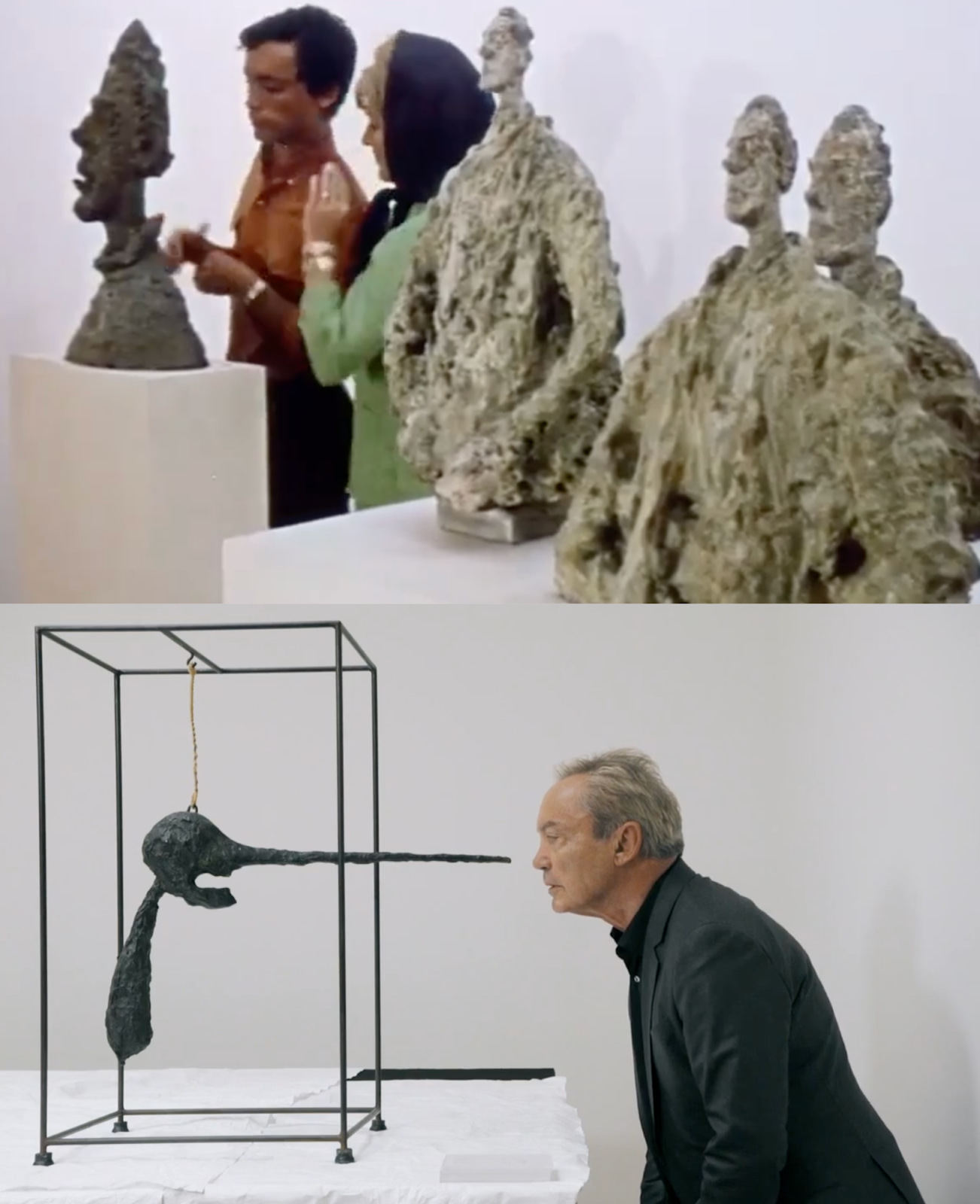
In 2014, in collaboration with director Hermann Vaske, Kier made the documentary Arteholic, a personal odyssey through his passion for modern art, in which he speaks to old artist friends (living and dead), skips through some of Europe's most elite galleries like a child hopped up on too much sugar and nearly pulls the locked door of a small gallery space off its hinges, impatient to get to an archive of Robert Mapplethorpe photographs, which includes a portrait of himself taken in 1983. He sits in a cafe reciting the opening paragraph from Joyce's A Portrait of the Artist as a Young Man and wraps himself up like a Christo piece. Kier understood his own art in relation to the art of his friends, extending to the art of strangers as an iterative life-force. "When your blood vessels explode, you have to die. You are dead," he says in the film's opening, lying on a gurney and hooked up to a strange, glowing red drip. Some critics called the film an 'ego trip', but that seems to be the typical response to this kind of biographical work, when artists unveil the personal. Why keep anything of beauty at an objective distance? Especially if you have permission to touch as well as look. There's a great satisfaction in watching a moment in Road to Saint Tropez where his character is chastised for trying to touch a sculpture, knowing that almost 50 years later he is given carte blanche to do so as he pleases in Arteholic: leaning in close to the canvases, skipping past one of Warhol's portraits of Elizabeth Taylor, talking about how he once got to kiss her, crouching on the ground to look at a sculpture of a dog and pondering if it is sleeping or dead.
In one scene, he lies on his therapist's couch, which at first looks like another comedy bit. He begins by talking about the joy he gets from buying art, turning the act of doing so into a kind of party trick, a performance in itself:
I bought myself a deer…it was broken. One of its back legs was broken. They didn’t want to sell it to me. I said, “That doesn’t matter at all.” Then I put a bandage on its leg, and blood was dripping on the floor. Whenever friends or journalists come by, everybody asks about the deer. I say, “That’s a Jeff Koons,” and they all believe it. Am I addicted to art? Somehow, it is also a desire to possess, a kind of greed.
Kier says that growing up in poverty explains his intense hunger not just for art, but for possessions. Recalling his past, he starts to tear up. No more bullshit. You start to feel you shouldn't be privy to the conversation. He recalls that when he was young in Cologne; he liked to watch his artist friends work—and struggle—with the creative process. He describes the moment when inspiration seemed to hit, and they became possessed by the idea, working nonstop until they were finished. Until they burnt out. Kier burnt himself out merely consuming art:
Well, I can’t really help it. If I spend too much time in a museum, I have to suddenly run out, somehow, everything starts flickering before my eyes. That’s why I can’t go on a museum tour that lasts all day, like many people can. And it gets worse and worse because I really intensely examine the things that I look at.
It sounds like he experienced something akin to the phenomenon known as Stendhal Syndrome, named for the French writer who became so overwhelmed by the art he saw in Florence that he became unwell, to the point of sickness and delirium.
In 2024, to mark his 80th birthday, an exhibition was held at the Kölnischer Kunstverein in his home city of Cologne called: 'UDO IS LOVE: Time is Sin – A Journey into the Extraordinary Life of Udo Kier.' It featured memorobillia spanning his entire career including a number of installations such as a short film by Jan Soldat called Staging Death, a supercut of all Kier's on-screen deaths. Exhibition curators Hans-Christian Dany and Valérie Knoll observed:
Kier sees the challenges of a collapsing reality as an invitation to throw it further into confusion. It seems to matter little to him whether anyone likes the poses he adopts in pursuit of this; his main concern is not to be boring. His need to be the centre of attention is also a search for what cannot exist. It does not satisfy itself, but rather is part of a long, interminable movement around an empty centre – a dance without a name, which can never be danced alone.
An elegant dance from Uwe Boll to Wim Wenders, a screaming limp from Rob Zombie to Guy Maddin. Eames chairs, doll's heads, ferns, a naughty ostrich, Art, sitting on a bullet thinking of power, twenty grams of coke and a bible, a sex club with Madonna, Art, wearing a chandelier as a hat, injured deer, plastic pony, eating dirt, Going ham, cooling it down and getting misty-eyed and pensive before going ham again. Like we all do. Until our blood vessels explode. Eventually, the Ouroboros must let go of its tail, and all those connections between art and the personal, creating and consuming, your real-life dad and your movie dads, will shatter. But it's okay, because when they do, you will no longer have any use for them, but the people you leave behind will.
The final scene of Arteholic sees Udo Kier carted out of a museum on a gurney. "Kunst!" ( Art! ) he shouts in delirium, "Kunst! Kunst! Kunst!" he wails as the ambulance doors slam shut. It's not a cry of sorrow or regret, it's a cry of acceptance and gratitude. A decade before his death, he was preparing to leave it all behind, shouting his heart out so that when the time came, he could exit with a gentle whisper.
*Beware!
A list of all the films I mentioned on Letterboxd.